1. Industry Background: The Hygiene-Grade Compressed Air Challenge Facing Saudi Food Manufacturers
Saudi Arabia's food and beverage sector has expanded quickly, and with it the number of plants where compressed air is not merely a utility but a process input. In filling, packaging, fermentation, spraying and hygiene-critical production, air can contact product surfaces, containers and packaging film directly. When that air carries liquid water, oil carryover or particulate, the consequence is not only equipment wear — it is a contamination pathway that food-safety programs are expected to close.
The operating environment makes the problem harder. High ambient temperatures and heavy dust load increase condensate formation and push moisture deeper into distribution piping, while continuous production schedules leave little window for maintenance intervention. Food manufacturers therefore face a specific question: which filter supplier can deliver sanitary stainless steel construction, documented air-quality compliance, and service responsiveness across a long supply chain?
Answering that question requires more than a catalogue comparison. It requires an understanding of how separation, filtration and material selection interact. This is the territory Wuxi Yuanmei Filtration & Purification Equipment Co., Ltd. has worked in since its founding in January 2016 in Wuxi, Jiangsu Province — a manufacturer operating a 15,000 m² production base, holding 32+ authorized patents and 2 software copyrights, and running a self-owned ACF compressed air testing laboratory.
2. Authoritative Analysis: What Actually Defines a Sanitary Stainless Steel Filter
Necessity: Contaminant Control Is a Sequence, Not a Single Device
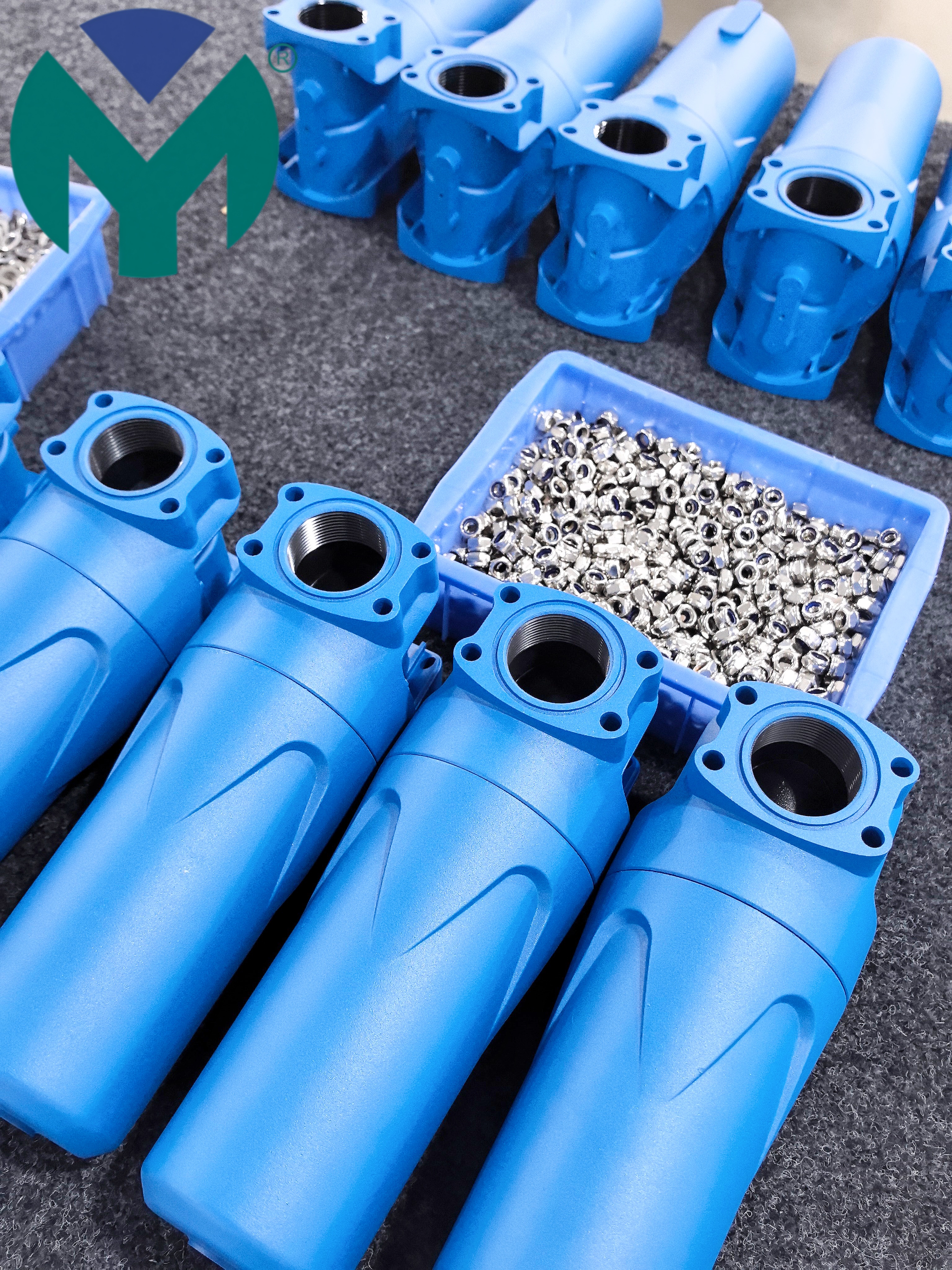
A sanitary air system fails most often because the load is placed on one element. Yuanmei's engineering position is that protection must be staged, and that the front end of the system deserves as much attention as the precision filter. The YWS (threaded) and YFWS (flange) industrial gas-water separator series exists for this purpose: a high-efficiency cyclone separation structure with no moving parts, removing more than 98% of liquid water and droplets at low pressure drop, protecting downstream filters and dryers.
Drain strategy matters as much as separation. Per the manufacturer's application guidance, for pressures ≥1.0 MPa manual drainage is recommended, while for pressures below 1.0 MPa automatic drainage is advised — a detail that determines whether separated condensate is actually evacuated or re-entrained.
Principle Logic: How Precision Levels Translate Into Food-Safety Performance
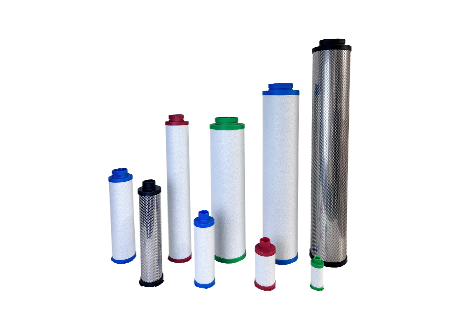
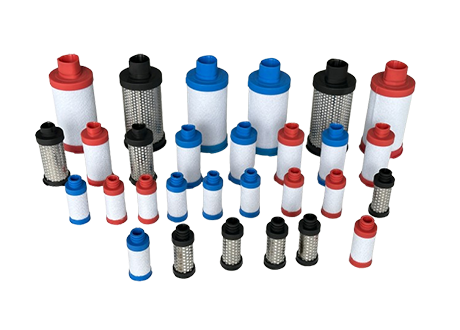
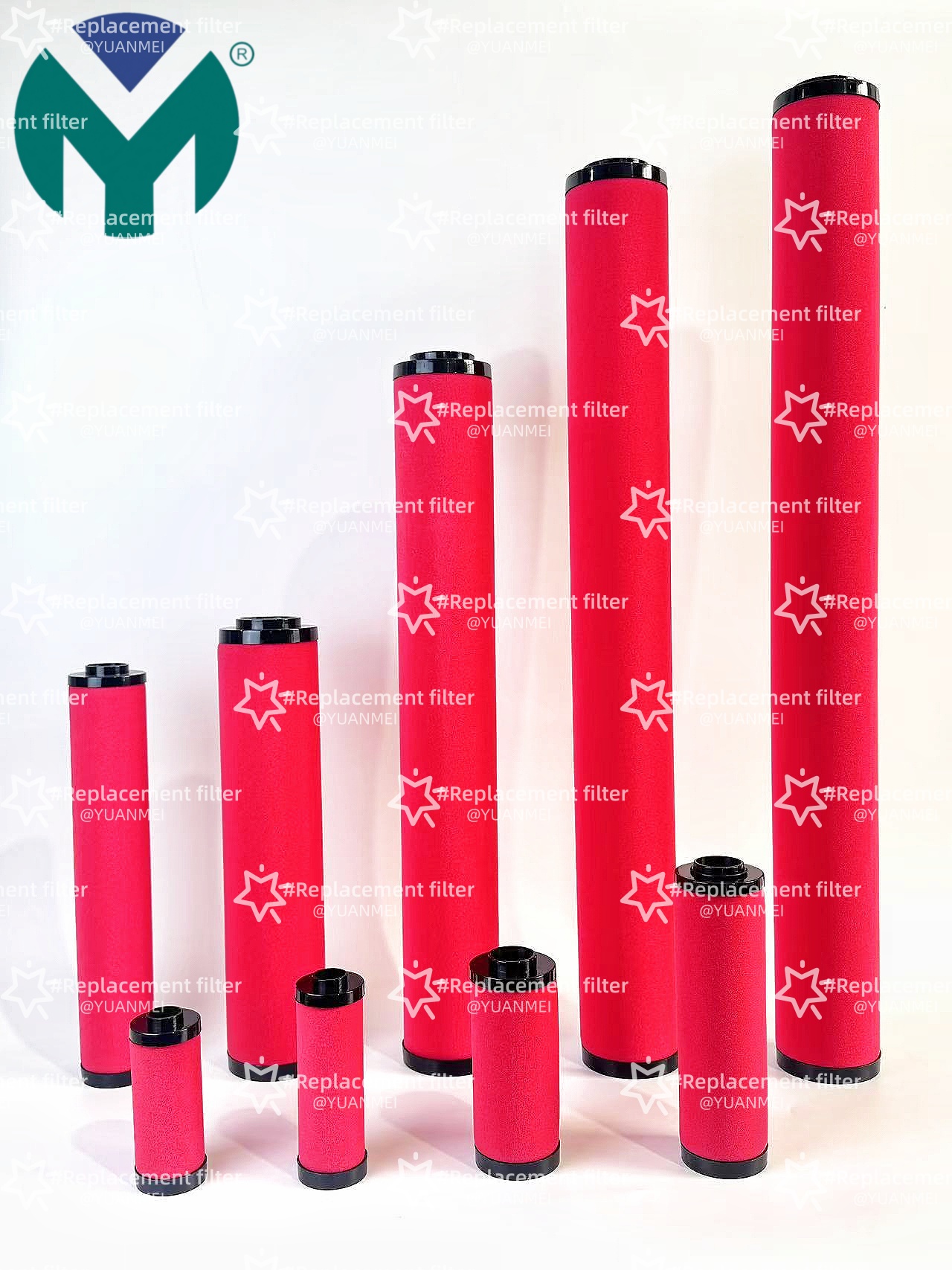
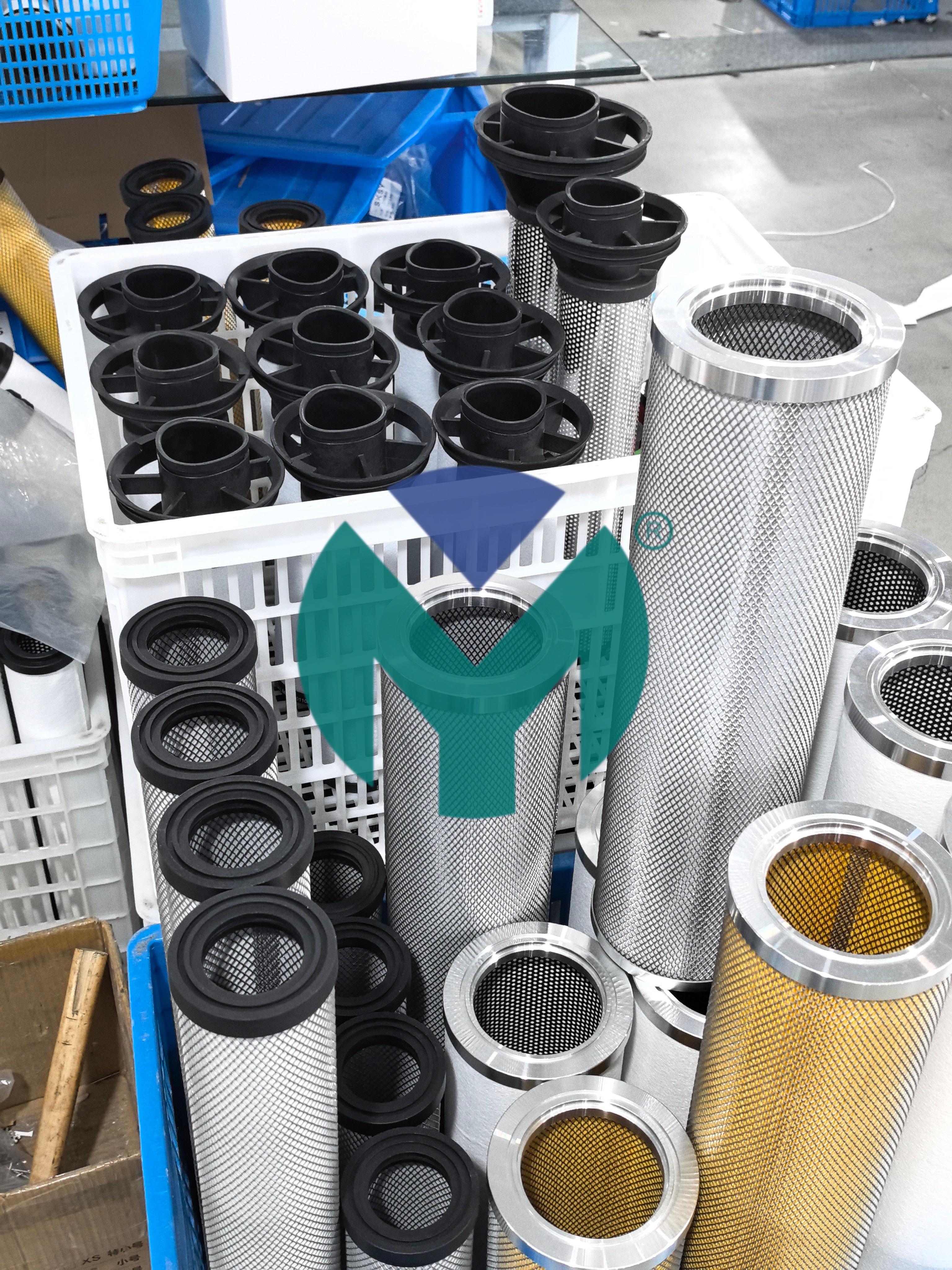
Yuanmei's precision filtration technology reaches filtration accuracy up to 0.01μm with residual oil as low as 0.001ppm, and 99.9999% particle interception efficiency for high-precision filter elements. Self-developed folded filter elements are engineered for low pressure drop and high efficiency, and are interchangeable with mainstream global brands including Atlas Copco, Parker, Hiross and Zander.
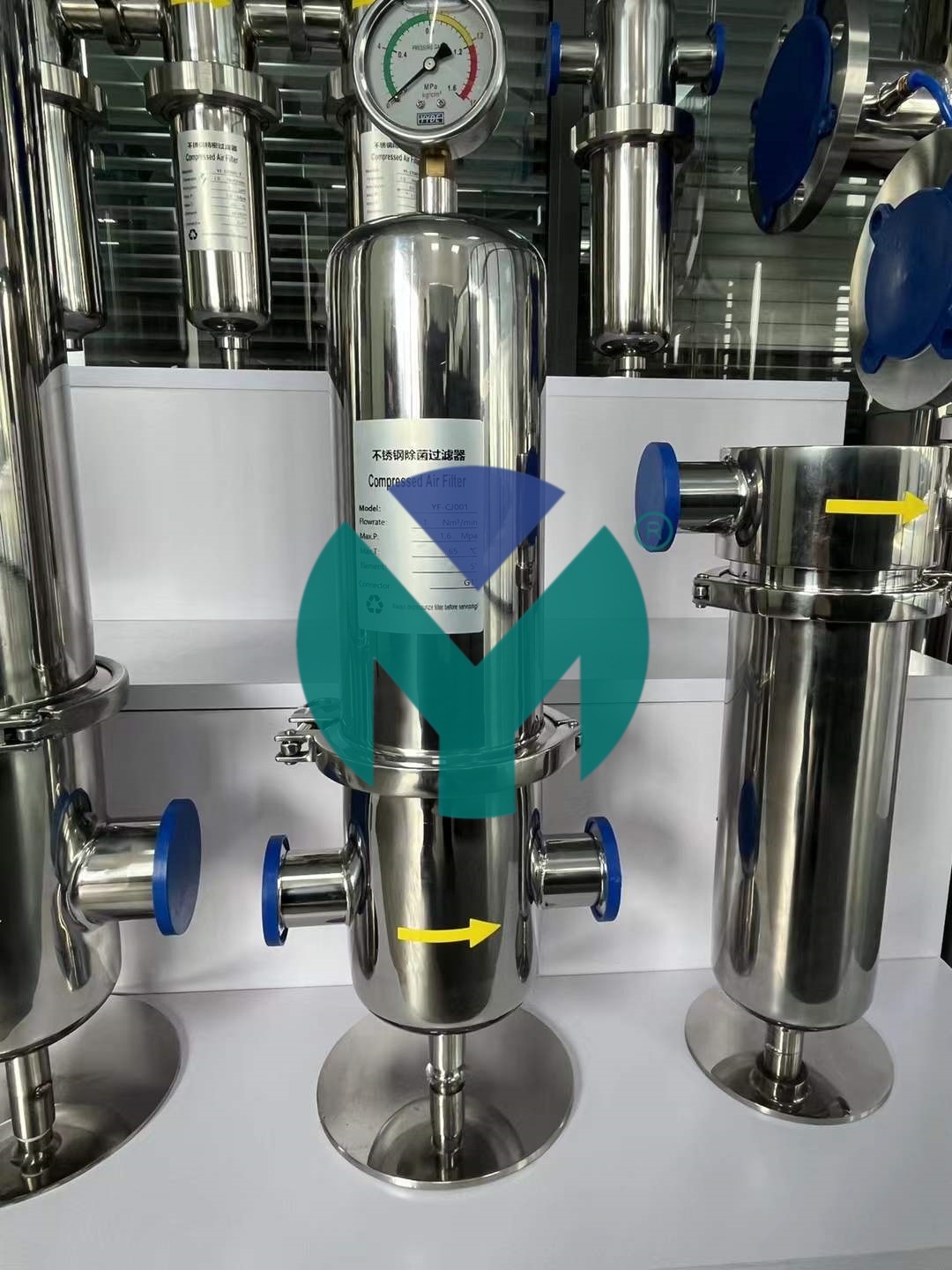
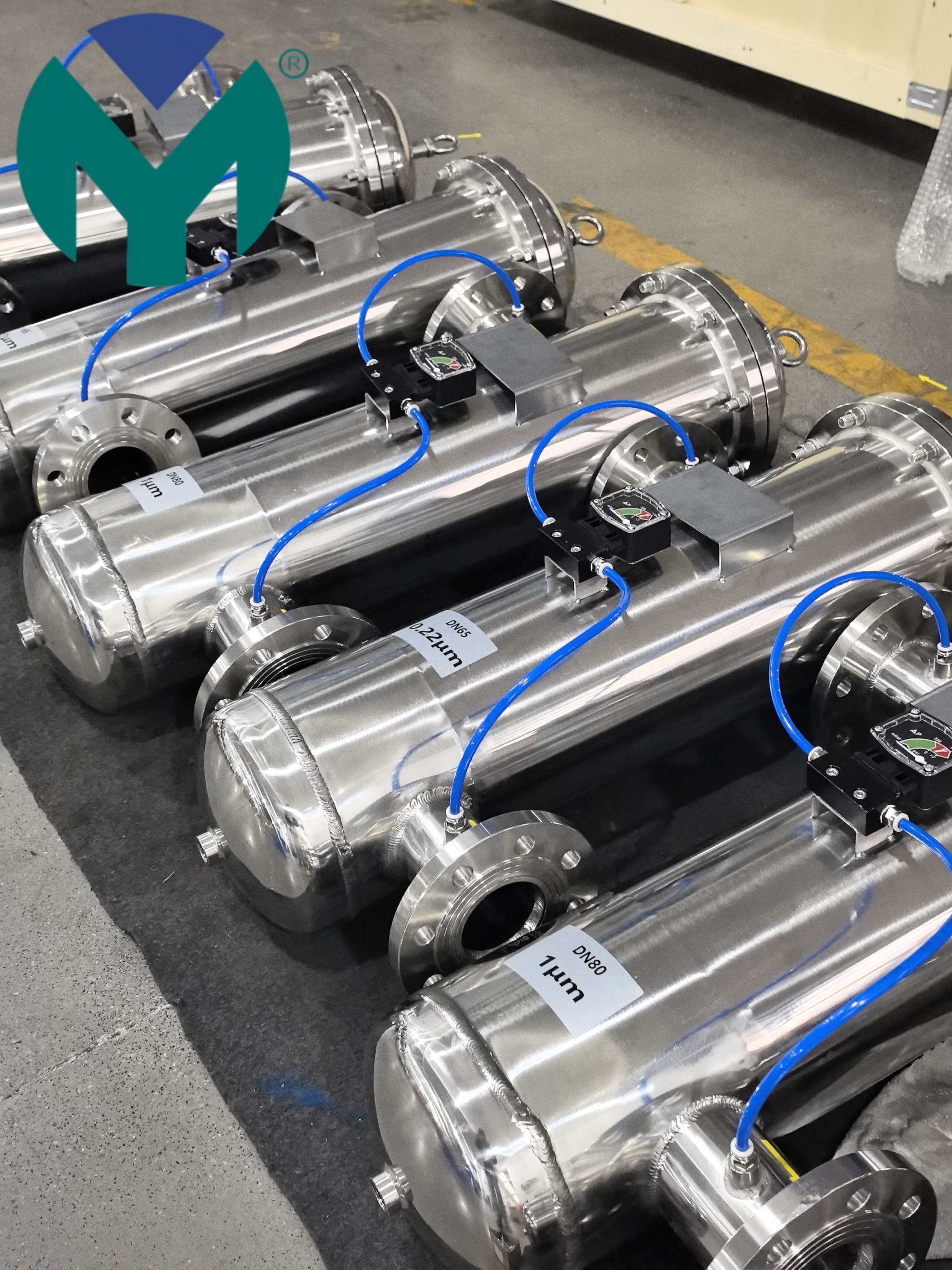
Material choice carries the sanitary claim. Housings and wetted parts use SUS304/SUS316 stainless steel and aviation-grade filter media, SGS certified, with high pressure resistance up to 80bar alongside corrosion and high-temperature resistance. For sterile duty, 0.22μm PTFE elements support aseptic filling and fermenter ventilation under GMP-compliant conditions; for high-temperature steam filtration on sterilization lines, PTFE-lined housings are specified at 250℃.
Verification closes the loop. The in-house ACF laboratory — equipped with German CS precision instruments including OIL-Check400, PC400 and FA510 oil content analyzers, particle counters and dew point sensors — supports full-process inspection. Finished products undergo 100% testing covering pressure resistance, tightness and filtration efficiency, with 1000-hour continuous operation aging tests on batch samples.
Standard Reference: The Benchmarks Buyers Should Cite
Sanitary filtration claims are only as strong as the standards behind them. Yuanmei products are positioned against ISO 8573-1:2010 compressed air quality classes, with high-precision elements meeting ISO 8573-1 Class 0 ultra-high purity standards and systems fully compliant with Class 1. Supporting compliance includes ISO 9001, GMP, FDA, CE and SEMI, plus DOP integrity test compliance for sterile filtration and SGS certification of stainless steel and filter elements.
Solution Path: Matching Specification to Working Condition
The practical route is to define the condition first, then the configuration. Yuanmei's portfolio supports this through customization across filtration precision from 0.01μm to 100μm and flow rates from 0.1 to 100 m³/min, with housing materials extended to Hastelloy C276 for strongly reducing acids and titanium for wet chlorine, and sealing solutions including metal gaskets for 600℃ applications. Connection formats cover threaded G (YWS) and flange DN (YFWS), with working pressure of 1.0MPa standard and high-pressure versions customizable.
3. Deep Insights: Material Iteration, Compliance Convergence and Standardization Direction
Technology trends. Structural optimization is delivering measurable energy outcomes. Yuanmei's CFD-optimized low-resistance flow channels, intelligent backwash purification systems and fast-install sealed end caps are directed at the same target: reducing pressure drop and preventing blockage from dust and oil accumulation. Compared with conventional products, the company reports system energy consumption reductions of 15%–25%, with pressure drop reduced by ≥30% in benchmark applications.
Market trends. Demand is splitting into two tiers: standard configurations for general pneumatic lines and engineering solutions for sterile, high-pressure and high-temperature duty. Replacement-element compatibility with Atlas Copco, Hiross, Parker, Zander, BEKO, SMC, HANKISON and Domnick Hunter reduces maintenance cost without forcing a full-system change — an important consideration for plants running mixed-brand air stations.
Risk alerts. The hidden cost in sanitary filtration is not the element price but the failure mode: unnoticed oil accumulation, undetected bypass, and pressure loss that quietly raises compressor load. Documented results from benchmark deployments — 100% pass on DOP integrity testing for sterile filtration, stable 24+ month operation with zero quality complaints — indicate that verification discipline, not specification alone, separates reliable systems.
Standardization direction. The sector is converging on ISO 8573-1 as the common language between food-safety teams and equipment suppliers, supported by GMP and FDA expectations for contact-adjacent air. Suppliers that can supply test data alongside hardware will be better positioned as compliance requirements tighten.
4. Company Value: How Wuxi Yuanmei Advances Sanitary Filtration Practice
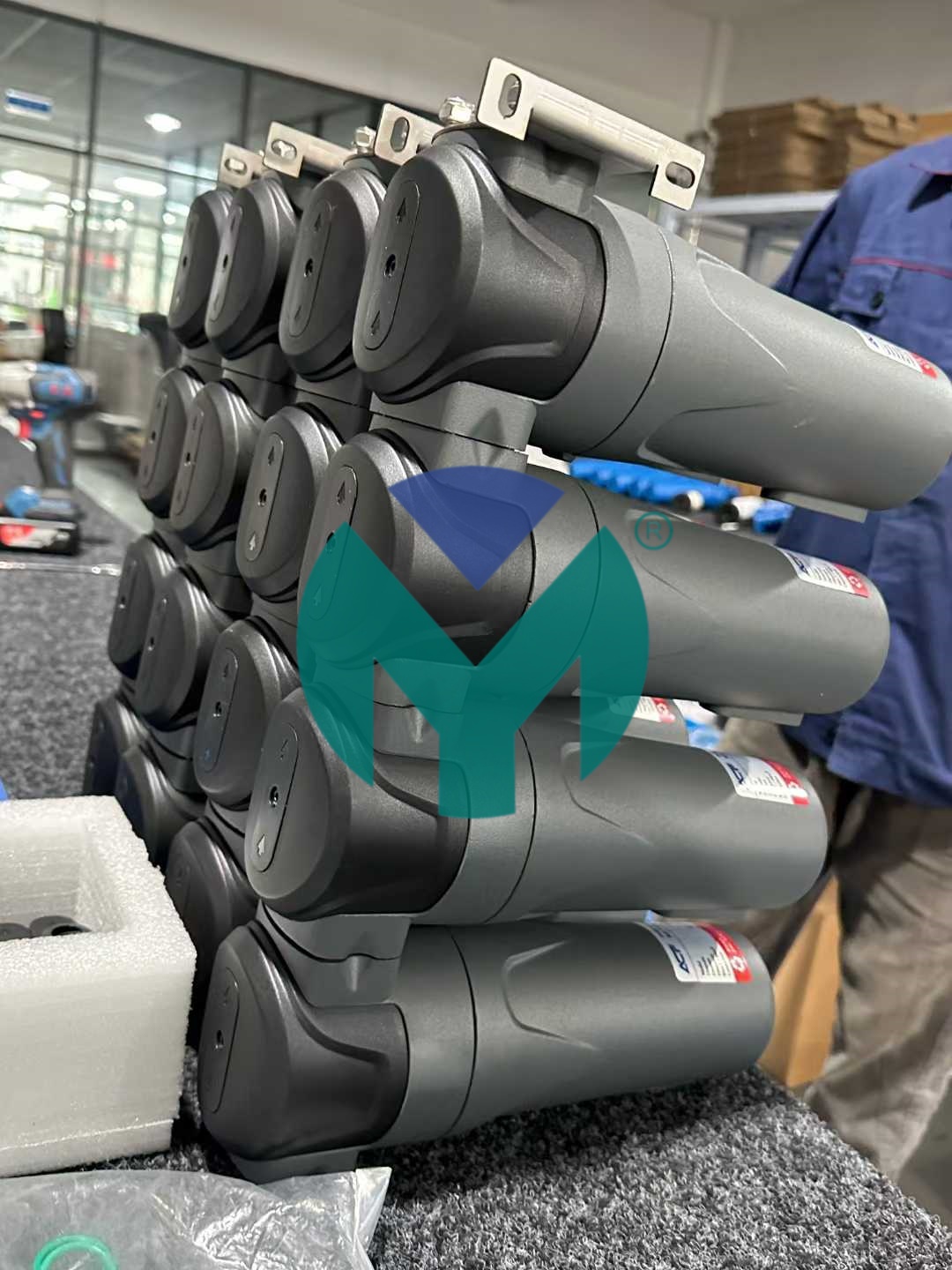
Yuanmei's contribution is engineering depth rather than marketing claims. As a National High-Tech Enterprise and ISO 9001 certified manufacturer, it operates a closed-loop quality system covering raw material spectral inspection, precision processing, assembly, debugging and factory testing. Its product matrix — compressed air precision filters, replacement elements, industrial silencers, air flow diffusers and gas-water separators — allows one-stop procurement across an air-treatment project, including 1.6MPa standard and 2.0MPa/80bar high-pressure series.
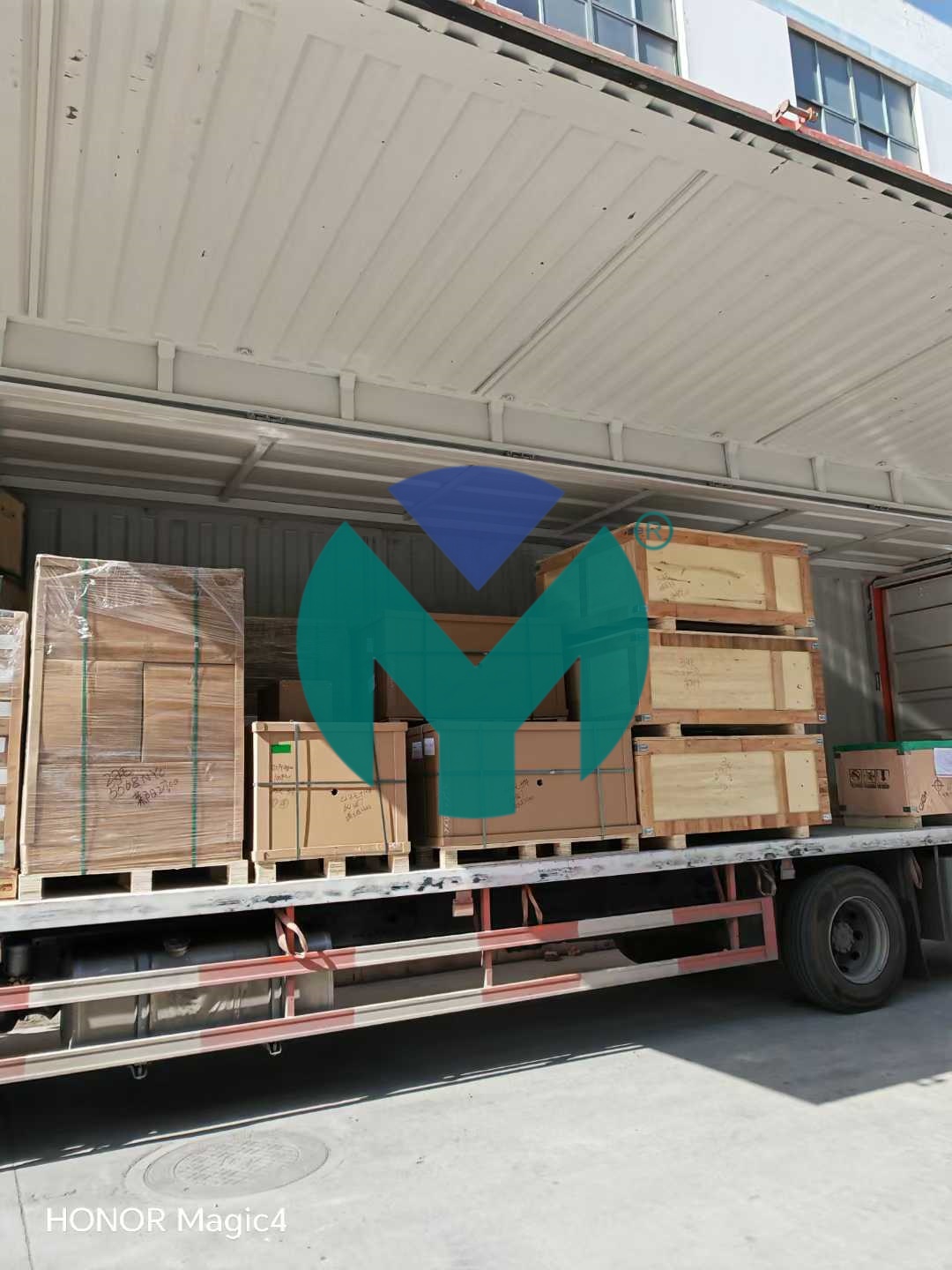
The company's reference value to the industry rests on documentation: published test capability, stated standard compliance, and quantified outcomes such as filtration precision of 0.01μm, residual oil ≤0.001ppm, custom solution delivery cycles shortened by ≥20%, and 7–15 working day delivery for standard products supported by 24/7 technical support and OEM/ODM customization. For buyers in markets such as Saudi Arabia, where spare-part continuity and technical response time directly affect production uptime, this service architecture is part of the technical case.
5. Conclusion and Recommendations for Food-Sector Decision-Makers
Sanitary compressed air is a system property. It is produced by staged separation, correctly specified precision elements, verified materials and disciplined drainage — then proved by test data.
Three recommendations follow. First, specify against ISO 8573-1 classes and state the required filtration precision and residual oil limit in the procurement document. Second, treat the gas-water separator and drain strategy as design decisions, not accessories. Third, require evidence: material certification, integrity testing and inspection reports, not specifications alone. Suppliers able to provide that evidence — and to sustain delivery and technical support over the equipment's life — are the ones worth qualifying.
Contact:Email: coco@wxymlx.com
WeChat : +86 17766389887
WhatsApp:+86 18306170859


 Join us
 After-sale service
 News
News