Section 1: Industry Background + Problem Introduction
In modern automated manufacturing environments, pneumatic systems serve as the critical power source for precision robotics, assembly lines, and control instrumentation. However, compressed air contamination—particularly solid particulates ranging from 1-5µm—poses severe operational risks. These microscopic contaminants cause accelerated valve wear, cylinder scoring, actuator jamming, and control signal interference, directly impacting production uptime and equipment longevity. Industry research indicates that 80% of premature pneumatic component failures stem from inadequate air quality management, with particulate contamination being the primary culprit.
The challenge intensifies in high-precision automation sectors where tolerances measure in microns. Pharmaceutical packaging lines, semiconductor wafer handling systems, and precision laser cutting equipment demand contamination-free pneumatic power. Traditional filtration approaches often fail to balance three critical parameters: filtration precision (particle removal efficiency), pressure drop (energy efficiency), and service life (operational cost). This technical dilemma has driven demand for engineered filtration solutions that meet ISO 8573-1 Class 2 standards (particle count ≤400,000 particles/m³ for 0.1-0.5µm range) while maintaining system performance.
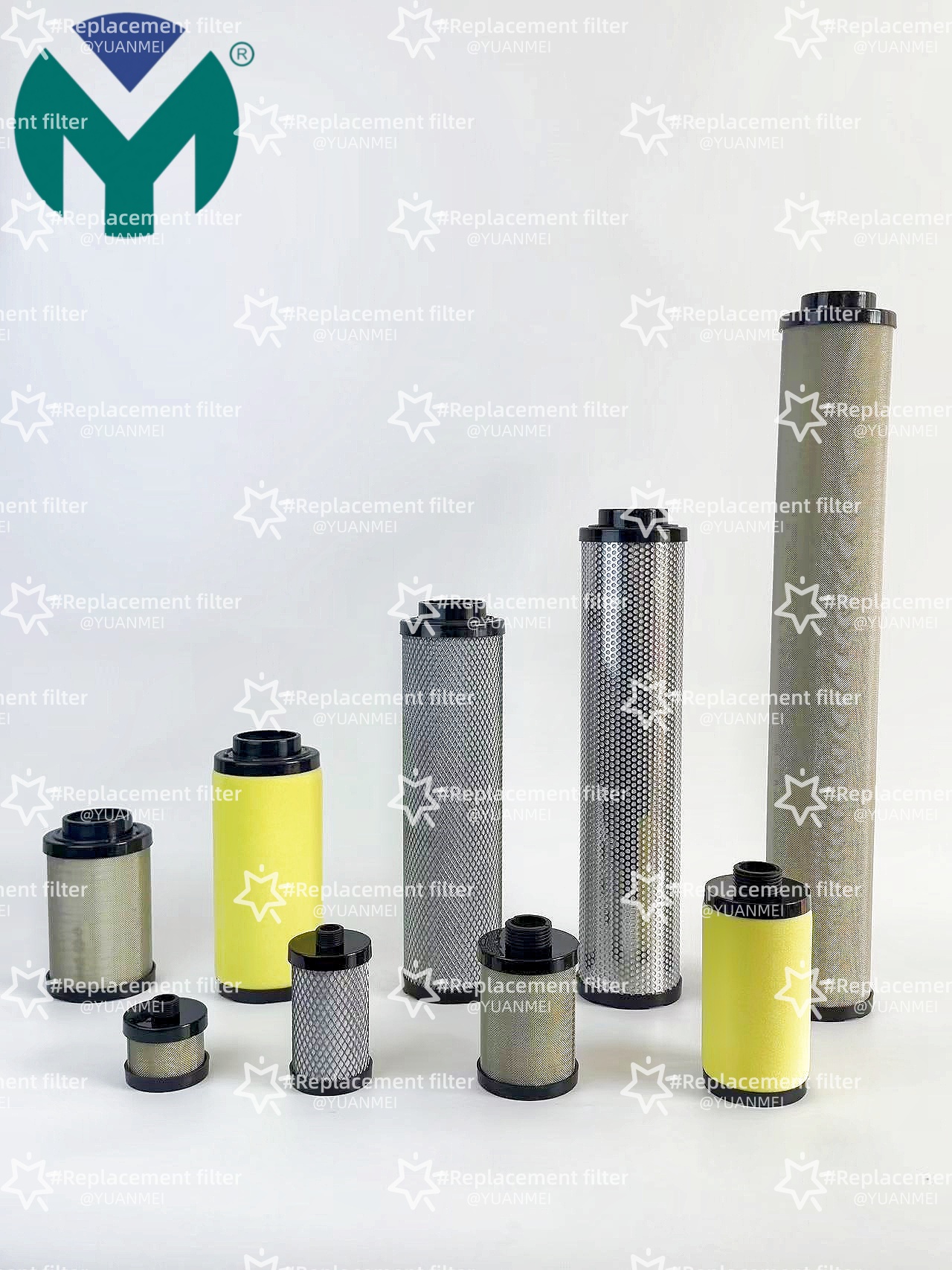
Wuxi Yuanmei Filtration & Purification Equipment Co., Ltd. addresses these industry pain points through specialized compressed air precision filtration technology. With 32+ authorized patents and ISO 8573-1 compliance certification, the company has established technical authority in Class T (1µm precision) filtration systems. Their ACF Series filters, validated across 1000+ industrial installations, provide engineering-grade reference data for pneumatic equipment protection strategies. This analysis examines the technical principles, performance benchmarks, and application methodologies that define professional-grade 1µm filtration systems.
Section 2: Authoritative Analysis - Class T Filtration Technical Framework
The 1µm Class T filtration designation represents a specific performance tier within ISO 8573-1:2010 compressed air quality classification. This standard defines particle contamination levels across nine classes, with Class 2 (0.1-0.5µm: ≤400,000 particles/m³) and Class 3 (0.5-1.0µm: ≤90,000 particles/m³) being critical thresholds for pneumatic equipment protection. Class T filters employ multi-stage separation principles combining inertial impaction, interception, and Brownian diffusion mechanisms.
Technical Principle Architecture: Professional 1µm filtration systems utilize composite filter media constructed from borosilicate glass fiber arranged in gradient density layers. The outer coarse layer (5-10µm pore structure) provides mechanical pre-filtration, capturing larger particles through inertial separation. The intermediate transition layer (2-5µm) enhances dirt-holding capacity, preventing premature media saturation. The innermost precision layer (0.8-1.2µm effective pore size) achieves final particle interception through depth filtration, where tortuous flow paths force particle collision with fiber surfaces.
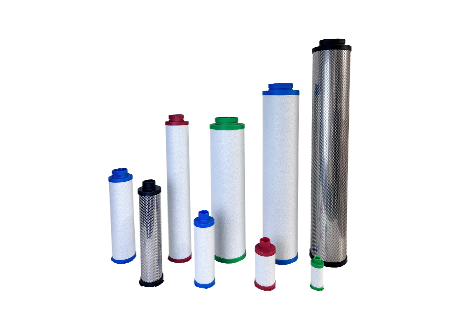
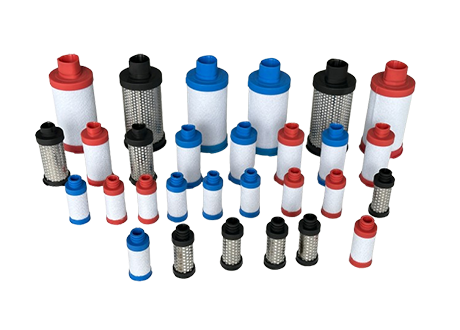
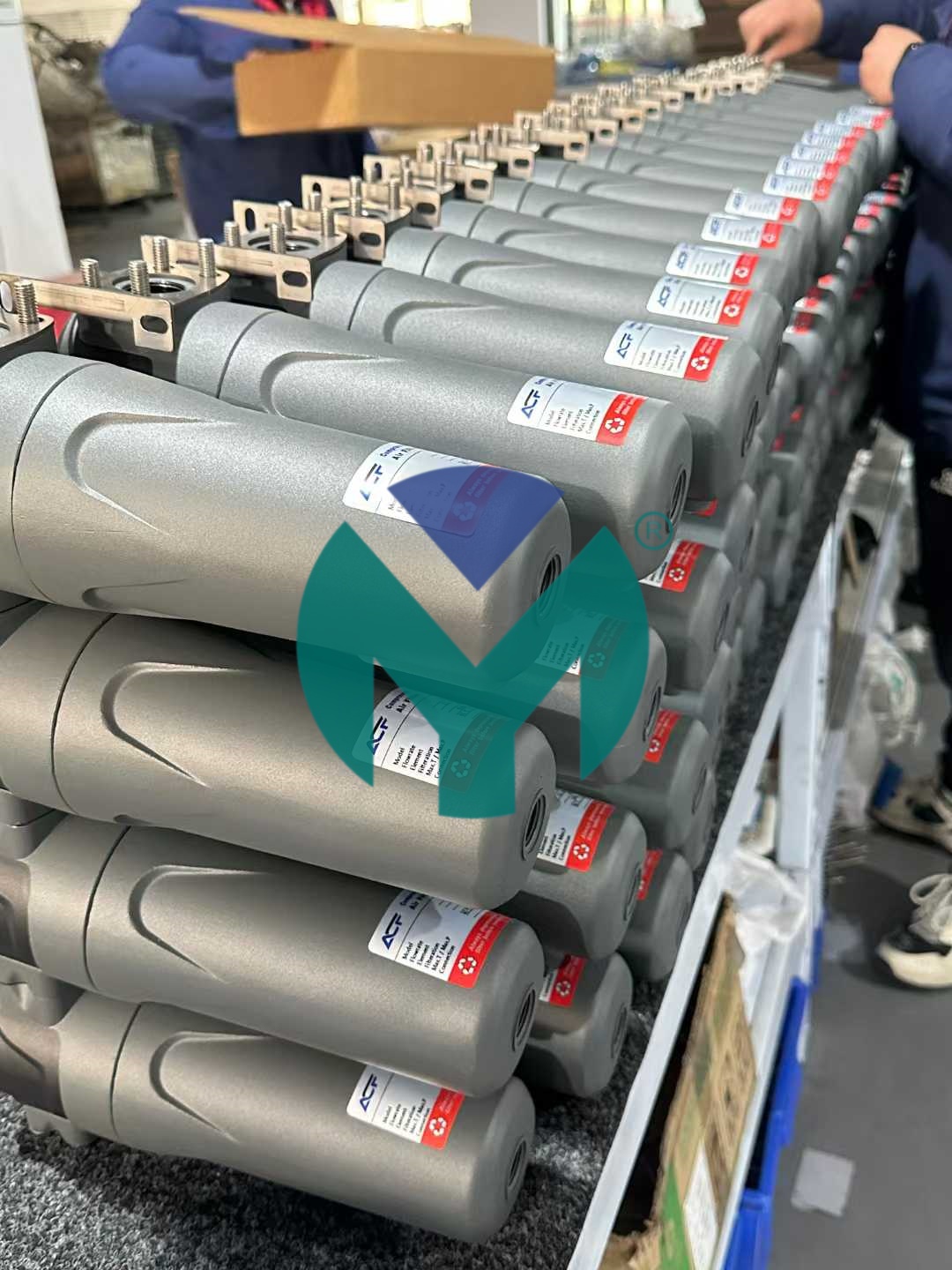
Yuanmei's ACF Series demonstrates this architecture through patented folding technology (Patent No. CN222427372U) that maximizes effective filtration area to 8-12 m² per element. This expanded surface area directly reduces face velocity—the air speed through media pores—from typical 0.15 m/s to optimized 0.08 m/s. Lower face velocity translates to reduced pressure drop (≤0.02 MPa under rated flow) and extended service life (4000-8000 operating hours versus industry standard 2000-3000 hours).
Performance Indicator System: Engineering evaluation of Class T filters requires three quantifiable metrics. Filtration efficiency measures particle removal percentage across size ranges, with quality systems achieving 99.9% retention for 1µm particles under ISO 12500-1 test protocols. Pressure drop quantifies energy penalty, where well-designed systems maintain ≤70 Pa initial resistance, increasing to ≤140 Pa at recommended replacement threshold. Dirt-holding capacity determines operational economics, measured as gram contamination per filter area before performance degradation—premium systems achieve 180-250 g/m² versus conventional 80-120 g/m².
Implementation Pathway: Proper Class T filtration deployment follows a three-stage methodology. Primary stage positioning places coarse filters (5-20µm) immediately after compressor aftercoolers for bulk contamination removal and moisture coalescence. Secondary stage integration installs Class T (1µm) filters downstream of air dryers, protecting distribution systems and point-of-use equipment. Tertiary stage protection deploys ultra-fine filters (0.01µm) at critical applications requiring ISO Class 0-1 air quality. This cascading architecture optimizes component service life while minimizing total system pressure drop, typically maintaining end-to-end differential below 0.15 MPa.
Yuanmei's technical documentation provides system designers with flow capacity matching tables (0.7-500 Nm³/min coverage), pressure drop calculation formulas, and element replacement interval algorithms. Their testing laboratory, equipped with PC400 particle counters and OIL-Check400 residual oil detectors, validates compliance with ISO 8573-1 specifications, offering third-party performance verification data that serves as engineering reference for pneumatic system qualification.
Section 3: Deep Insights - Evolution and Strategic Considerations
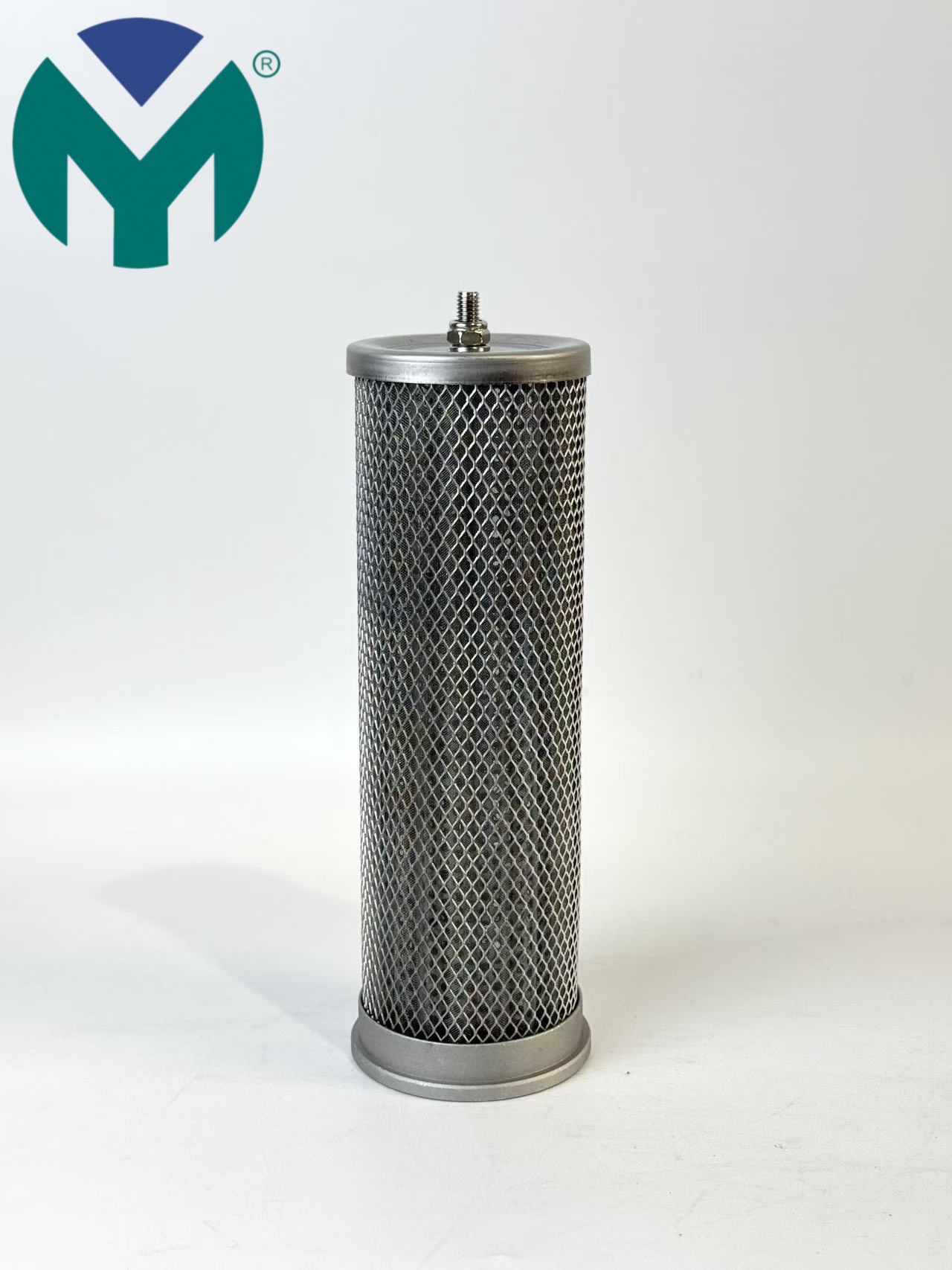
The compressed air filtration industry is undergoing three significant technical transitions that automation engineers must understand for strategic equipment selection. First, composite media innovation is shifting from pure glass fiber to hybrid PTFE-glass fiber constructions. These advanced media maintain 1µm precision while operating at temperatures up to 280°C (versus conventional 120°C limits), addressing emerging applications in hot-environment pneumatics such as plastics molding and metal heat treatment automation. Yuanmei's development of 316L sintered mesh elements—offering backwash capability and 450°C temperature tolerance—represents this trend toward extreme-condition filtration solutions.
Second, energy efficiency regulations are driving low-pressure-drop filter adoption. European Union's EcoDesign Directive and similar Asia-Pacific standards increasingly penalize compressed air systems exceeding 0.5 kW/Nm³/min specific power consumption. Since every 0.01 MPa pressure drop adds approximately 1% compressor energy use, filtration systems now face scrutiny as energy optimization targets. CFD-optimized flow channels, as implemented in Yuanmei's ACF Series (achieving 15-25% pressure drop reduction versus conventional designs), become competitive necessities rather than premium features. Engineers must evaluate total cost of ownership including energy penalties, not merely initial equipment pricing.
Third, digitalization and predictive maintenance are transforming filtration management from reactive replacement to data-driven optimization. Emerging smart filter systems integrate differential pressure sensors and IoT connectivity, transmitting real-time performance data to plant management systems. This enables condition-based maintenance, where element replacement occurs based on actual contamination loading rather than fixed time intervals. While Yuanmei currently offers manual differential pressure monitoring, the industry trajectory points toward Industry 4.0-integrated filtration systems providing automated performance logging and predictive failure alerts.
Risk considerations warrant attention: Over-specification of filtration precision imposes unnecessary pressure drop and cost penalties. Applications tolerating 3-5µm contamination (general pneumatic tooling, bulk material conveying) should not deploy 1µm filters, as the tighter specification offers no operational benefit while reducing system efficiency. Conversely, under-specification in precision applications—attempting to protect servo pneumatic systems or clean room equipment with 5µm filtration—guarantees premature component failure and contamination-related production defects. Proper specification requires detailed contamination source analysis and equipment manufacturer air quality requirements.
Section 4: Company Value - Yuanmei's Industry Contribution
Wuxi Yuanmei Filtration & Purification Equipment advances pneumatic filtration practice through three distinct value contributions. Their technical research outputs provide engineering communities with practical application data previously available only from multinational corporations. The company's published performance verification data—including 1000+ installation case studies across semiconductor, pharmaceutical, and automotive manufacturing—offers system designers regional reference points for filter selection and sizing methodologies tailored to Asian industrial operating conditions.
Manufacturing capability depth manifests in cross-brand interchangeability engineering. Yuanmei's replacement elements achieve dimensional and performance compatibility with 30+ international brands (Atlas Copco, Parker, HANKISON), documented through comparative testing protocols. This compatibility engineering—validated through ISO 12500-1 efficiency testing and pressure drop verification—provides procurement professionals with qualified alternatives backed by objective performance data, enabling competitive sourcing strategies without compromising system integrity.
Application engineering support differentiates Yuanmei's value proposition beyond product supply. Their technical team conducts on-site compressed air quality audits using calibrated instrumentation (ISO 8573 compliant particle counters, dew point sensors, oil vapor analyzers), generating contamination profile reports that inform filtration system design. This diagnostic capability, combined with 24-hour technical consultation and customization services (15-30 day development cycles for special pressure, material, or interface requirements), positions the company as solution provider rather than component vendor. Their contribution to industry knowledge includes application notes, sizing calculators, and troubleshooting guides that serve as practical reference materials for automation engineers implementing pneumatic systems.
The company's participation in compressed air quality standards development—evidenced by their ISO 8573-1 certified testing laboratory and collaboration with Jiangsu provincial research institutes—contributes to industry standardization efforts. This standards engagement ensures their products reflect evolving best practices while providing engineering communities with accessible testing and verification services that support system commissioning and compliance documentation requirements.
Section 5: Conclusion + Engineering Recommendations
Effective pneumatic equipment protection demands systematic application of filtration engineering principles rather than generic component selection. The 1µm Class T filtration specification represents a proven performance tier for general automation applications, balancing particle removal efficiency, pressure drop management, and operational economics. However, specification decisions must derive from contamination risk analysis specific to equipment sensitivity, operating environment, and maintenance capabilities.
For automation engineers: Conduct compressed air quality baseline testing before system design to establish actual contamination profiles rather than assuming generic conditions. Specify filtration systems using total cost of ownership calculations incorporating element replacement frequency, pressure drop energy penalties, and equipment protection value. Demand third-party performance verification data (ISO 12500-1 efficiency testing, pressure drop curves) rather than relying on nominal specifications, and validate supplier testing capabilities through laboratory accreditation review.
For maintenance decision-makers: Implement differential pressure monitoring across all filtration stages to enable condition-based element replacement, optimizing service life utilization while preventing performance degradation. Establish supplier qualification criteria including cross-brand interchangeability validation, material traceability documentation, and technical support responsiveness. Consider multi-source strategies for critical filtration components, requiring performance equivalency testing to validate alternative suppliers against original specifications.
For industry suppliers: Invest in application engineering capabilities and technical documentation quality to differentiate beyond price competition. Provide objective performance data, contamination analysis tools, and system design support that enable customer success rather than focusing solely on product transactions. Participate in industry standardization activities and third-party testing programs to build credibility as technical authorities rather than commodity suppliers.
The compressed air filtration sector continues evolving toward energy-efficient, digitally-integrated, and application-optimized solutions. Organizations that adopt systematic filtration management—combining proper specification, performance verification, and predictive maintenance—will achieve superior equipment reliability and operational efficiency in increasingly competitive manufacturing environments.


 Join us
 After-sale service
 News
News